
Power Plant and Data Center Story Archive
Plus, a scorecard on where elected officials and others stand on the controversy

Country Roads News was the first news source to report on the proposed power plant and data center complex near Davis and Thomas, and we’re staying on top of new developments.
Below is a compilation of the major stories published on this issue, and a listing of where prominent local leaders and organizations stand. This page will be updated regularly, so you can bookmark it as a handy reference guide.
The stories are listed in reverse chronological order.

Governor Patrick Morrisey promised to meet with local residents to hear their concerns, but so far he has held no public appearances in Tucker County since taking office.

The company seeking to build a power plant and data center complex in Tucker County revealed new details of its plans Friday that include one of the largest solar fields in the nation. Also, the Speaker of the state legislature is hired to represent another data center client.

In addition to his leadership role in the state legislature, Roger Hanshaw is an attorney who has repeatedly represented industries with an interest in state lawmaking and regulation.

Three groups filed an appeal seeking to overturn recent decisions by state regulators to approve a proposed natural gas-fired power plant near Davis and Thomas. Also, the state legislative ends with Senate President Randy Smith taking no action on his pledge to restore local control over data centers.

State Senator Randy Smith, Tucker County’s most powerful representative in Charleston, has taken no action on his pledge to restore some local control over data centers. Meanwhile, Tucker County’s other representative in the state Senate, Jay Taylor, said he is fully supportive of past and ongoing efforts to make the state more welcoming to data centers.

Fundamental Data, the company seeking to build a large power plant near Davis and Thomas, scored a victory Thursday when a state board rejected multiple claims made by groups seeking to block construction of the facility.

A high-ranking state official agreed to get involved in discussions over a proposed power plant and data center complex near Davis and Thomas, raising hopes that the site of the facility might ultimately be moved to a different location within the county.

“I’ll be honest with you, I had a hard time voting for it,” said West Virginia Senate President Randy Smith, a powerful backer of the controversial new state law boosting data center development. He added, “it’s hard on your political career to kill a governor’s bill.”

Country Roads News invited supporters of a proposed power plant and data center complex to share their views publicly. More than 4,000 people viewed that invitation. Three people who support the facility agreed to provide their views for publication.

Tucker County Commission President Mike Rosenau has said he won’t take sides on the local power plant and data center controversy, but his recent public comments indicate that he views the project favorably. His fellow County Commissioner Fred Davis also appears supportive.
State Air Quality Regulators Approve Permit for Power Plant Near Thomas
The West Virginia Department of Environmental Protection approved a permit for construction of a power plant near Davis and Thomas, ruling that the proposal will “meet all applicable state and federal air quality rules and regulations.” The department said it received 1,605 written comments from the public about the permit application, with most of them expressing opposition to the power plant.

In October 2024, the company held public meetings in Davis and Thomas to share its vision of environmentally friendly growth and development on its landholdings in the area. However, public records indicate that company officials left an important piece of information out of the presentations.
Report Says Data Center ‘Microgrid’ Law Violates State Constitution
The West Virginia Center on Budget and Policy also says the law leaves numerous issues unresolved for local officials, such as whether a county health department could regulate food services or sewage disposal at a data center.

The Tucker County Convention and Visitors Bureau, Tucker County Chamber of Commerce, the Tucker County Development Authority, and all but one municipality in the county so far have taken no position on the controversial proposal.

West Virginia regulators made it clear in a June 30 hearing that they are almost certain to approve an air quality permit for the power plant despite strong opposition from many local residents. Opponents are seeking other ways to block the project.

The power plant likely will tap into groundwater for cooling, a prospect that worries many local officials. Meanwhile, state regulators downplay the impact of the project on area residents. Also, the Tucker County Commission declines to take a position on the power plant.

Opponents of the power plant and data center complex try to convince the Thomas City Council to take a stand against it, but council members say they need more information.

The Davis Town Council voted, 5-0, on May 31 to express its opposition to a proposed power plant and data center complex between Davis and Thomas, marking the first time a Tucker County governmental body takes an official stand on the issue.

A letter from Fundamental Data to state pollution regulators sheds new light on the company’s plans, and seeks to assure the public that pollution, excessive water use, and other concerns raised by opponents won’t be a problem.

The office of Fundamental Data sits 130 miles east of Tucker County in a row of modest businesses in Purcellville, Virginia. The name “Fundamental Data” doesn’t appear anywhere on the building. Instead, the office suite carries the name CaseCo, a local construction company.

The deregulatory legislation expedites the state approval process needed to build data centers and strips local governments of any authority to stop data centers from springing up in their communities. The bill also diverts most of the property tax revenue from data centers to state coffers. That money that typically would go to local schools and municipalities.

A group of concerned residents creates Tucker United, a coalition opposing the the proposed power plant and data center complex. Meanwhile, State Senator Randy Smith, whose district includes Tucker County, said the opponents of the power plant are “people who have vacation homes who would prefer the area stay clear of any development at all.”

A close look at the timeline of the proposed data center shows months of secret planning for the facility, and then a rapid burst of activity in the West Virginia legislature to pass legislation favorable to the industry.

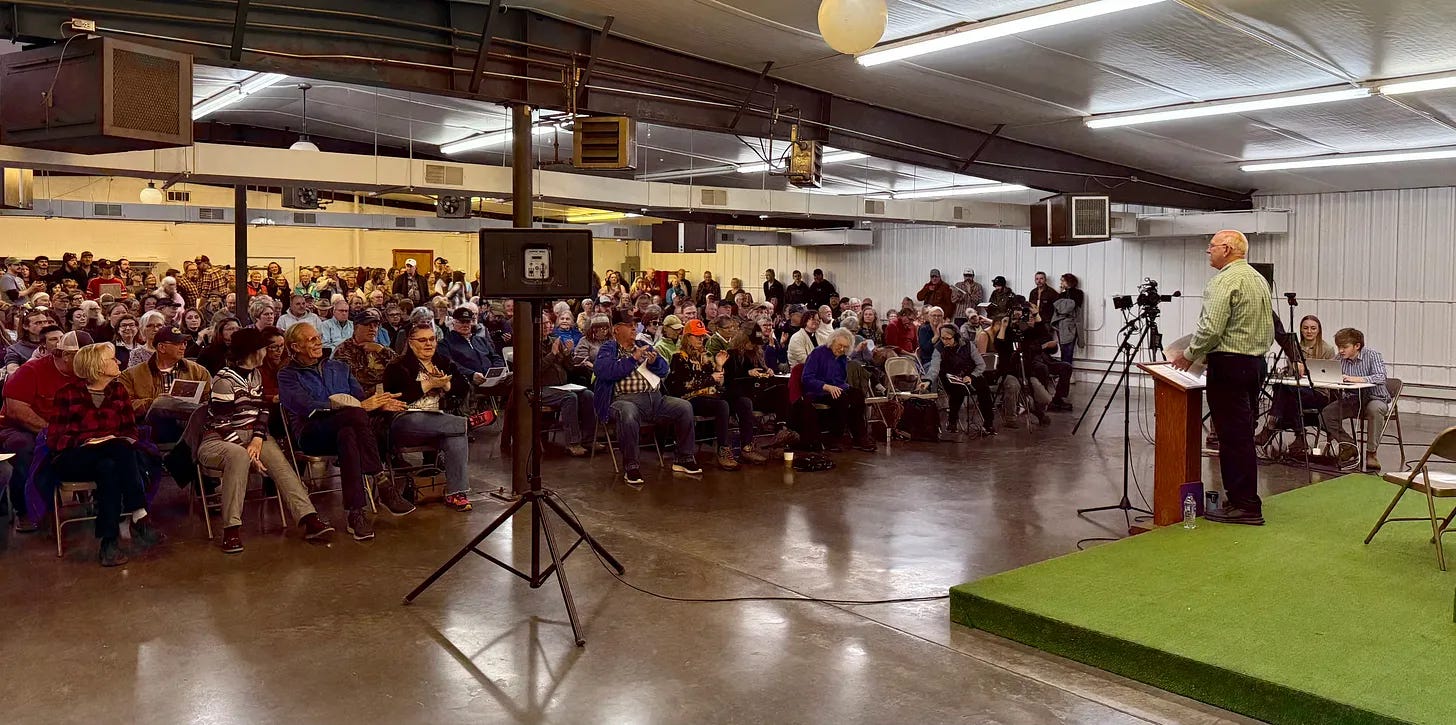
About 275 people packed into the Davis fire hall to express concerns that a proposed power plant and data center nearby would yield few family-supporting jobs while producing enormous amounts of air, water, noise, and light pollution.

The “microgrid” bill advancing in the state legislature would divert all new property taxes generated by data centers away from local schools and municipalities and instead direct it to the state of West Virginia. (Shortly after Country Roads News reported on this aspect of the bill, the legislation was amended to allow municipalities to keep about a third of the new property tax revenue, although schools still get nothing).

Regulatory filings reveal that a secretive Virginia company wants to build an large self-contained power plant between Davis and Thomas for what appears to be a data center complex. The plans call for the power plant to run on natural gas, with 30 million gallons of diesel fuel stored on site as a backup fuel source.
Where Local Officials and Organizations Stand
Country Roads News is tracking where prominent local officials and organizations stand on the proposed power plant and data center complex.
In Favor or Leaning Supportive
Tucker County Commission. The three-member body hasn’t taken an official stand on the issue. However, Commission President Mike Rosenau, the county’s top elected official, and fellow commissioner Fred Davis have made supportive comments. Commissioner Tim Knotts has been largely quiet on the controversy.
Opposed
Davis Town Council. The Davis Town Council voted, 5-0, on May 31 for a resolution expressing strong opposition to the facility.
No position
Thomas City Council. The City Council heard debate on the facility at a June 10 meeting but took no position on it. Mayor Jody Flanagan and other members of the council said they need more information before taking a position.
Parsons City Council. The City Council heard a presentation June 17 from opponents of the power plant but did not debate the issue or indicate whether the council will take it up again in the future.
Tucker County Convention and Visitors Bureau, and Tucker County Chamber of Commerce. “At this time we’re not taking a position,” said Jessica Waldo, executive director of both organizations, in response to an inquiry from Country Roads News.
Tucker County Development Authority. Executive Director Steven Leyh said in response to an inquiry from Country Roads News that his organization has not taken a position on the facility and has no plans to do so. At an April 13 community meeting in Davis, Leyh called for more information and dialogue about the project, saying that good corporate leaders “don’t shove things down your throat.”
Follow the money
Dan, I am a weekly newspaper journalist covering a proposal to bring a dc to our area. Would you be available to discuss some of the issues surrounding them?